4-Hour Face-to-Face Programme
Mindful Soundfor Workplace Performance
Workplace Stress·Mindful Awareness·Positive Interaction
 Trainer
Anna Lim
4 HoursFace-to-Face3 Learning Outcomes
Three things we will do today
Welcome
Today we will explore simple and practical ways to —
01
Recognise
Common signs of workplace stress.
02
Experience
Mindful awareness through sound.
03
Apply
Positive interaction in everyday work situations.
Key message
Awareness begins by noticing what is happening in the present moment.

Anna Lim
Trainer | Mindfulness & Sound-Healing Practitioner
- 15 years of professional management experience
- Leadership experience in the construction industry
- Practical workplace and participant-centred training approach
- Integrates mindfulness and sound awareness into workplace well-being learning
Training approach
Workplace Experience+Mindful Awareness+Participant-Centred Learning
Supporting
CalmFocus
ResiliencePositive Interaction
Activity
Icebreaker · Let's connect
Introduce yourself
Please share —
01
Your name
What would you like us to call you?
02
Your role
What do you do?
03
Your check-in word
Choose one word that describes how you feel right now.
Check-in words
CalmBusyTiredFocusedCuriousExcited
There is no right or wrong answer.
Simply notice how you arrive today.
Programme Flow
Our 4-hour learning journey
01
Stress Awareness
Recognise common signs of workplace stress.
45 MIN
02
Mindful Sound & Relaxation
Learn a simple sound-awareness process.
45 MIN
03
Positive Workplace Interaction
Explore practical positive interaction at work.
30 MIN
Experience
Guided Sound Relaxation
30 MIN
Close
Recap · Assessment · Closing
15 MIN
LO1
Identify at least TWO common signs of workplace stress.
LO2
Demonstrate ONE simple mindful relaxation technique using sound awareness.
LO3
Identify ONE practical action to manage stress and support positive interaction at work.
Learning outcomes
Identify 2 → Demonstrate 1 → Identify 1
01
Module · 45 minutes
Stress Awareness
Recognise→Understand→Become aware
LO1
By the end of this module, participants will be able to:
Identify at least TWO common signs of workplace stress.
Key message
Recognising stress is the first step towards responding to it appropriately.
Definition
What is workplace stress?
Workplace stress is the physical, mental or emotional pressure that may occur
when work demands become difficult to manage.
Pressure may come from
Workload
Too much to manage
Time
Urgent deadlines
People
Communication difficulties
Change
Changing priorities
Rest
Insufficient opportunity to recover
Remember
Different people may respond differently to the same workplace situation.
Sources of Pressure
What may create pressure at work?
01
Heavy workload
- Multiple responsibilities
- Too many tasks at the same time
02
Tight deadlines
- Urgent requests
- Limited time
03
Communication difficulties
- Misunderstandings
- Difficult interactions
04
Changing priorities
- Unexpected changes
- Competing demands
05
Lack of adequate rest
- Long periods of work
- Insufficient recovery time
Key message
A stressor is a situation or demand that may create pressure.
Know the difference
Stressor or stress sign?
Stressor
What may create pressure
Example
Tight deadline
→
Stress sign
What we may notice in ourselves
Examples
TirednessDifficulty focusingIrritability
StressorWhat is happening
Stress signWhat I notice
Three areas to notice
How can stress show up?
Stress may show up through —
Area 01
Body
Physical signs
Area 02
Thoughts
Mental signs
Area 03
Feelings
Emotional signs
Key message
Stress does not always look the same.
Learning to recognise different signs helps build awareness.
Area 01 of 03
Physical signs
What we may notice in the body
Common examples
Tiredness
Feeling physically drained
Muscle tension
Feeling tight or tense
Difficulty relaxing
Finding it difficult to settle after pressure
Ask participants
“What physical signs might you notice after a demanding working day?”
Key message
Our body can give us signals that pressure is building.
Area 02 of 03
Mental signs
What we may notice in our thoughts
Common examples
Overthinking
Thoughts keep going around
Difficulty focusing
Harder to maintain attention
Forgetfulness
More difficulty remembering information or tasks
Ask participants
“What happens to your concentration when several things require your attention at once?”
Key message
Workplace pressure may affect our attention and thinking.
Area 03 of 03
Emotional signs
What we may notice in our feelings
Common examples
Irritability
Becoming easily annoyed
Feeling overwhelmed
Feeling that there is too much to manage
Frustration
Feeling upset when things do not go as expected
Ask participants
“How might these feelings affect the way we communicate with colleagues?”
Key message
Our emotional state may influence workplace interaction.
Impact at work
Stress may affect…
Focus
- Difficulty concentrating
- Difficulty making decisions
- Forgetfulness
Emotions
- Irritability
- Feeling overwhelmed
- Frustration
Work performance
- Reduced efficiency
- Difficulty completing tasks
- Difficulty staying engaged with work
Key message
Stress may influence how we think, how we feel and how we perform.
Activity
Workplace scenario · Spot the signs
Meet Sarah
The situation
Sarah is managing several urgent deadlines.
Recently
- She feels tired during the working day.
- She finds it difficult to concentrate on her tasks.
- She becomes easily irritated when colleagues approach her.
Discuss
What signs of workplace stress can you identify?
Are they
PhysicalMentalEmotional
Trainer reveal
Tiredness→Physical
Difficulty concentrating→Mental
Irritability→Emotional
Activity
Group activity
Identify & discuss
Think of a common workplace situation that may create pressure. Discuss —
1
What is the situation?
→
2
What stress signs might appear?
→
3
Which category?
PhysicalMentalEmotional
Example
Tight deadline→Difficulty focusing→Mental sign
Activity instruction
Small groups discuss and share one example.
LO1 Check
Assessment
Check your learning
Identify at least TWO common signs of workplace stress.
Sign 1
PhysicalMentalEmotional
Sign 2
PhysicalMentalEmotional
Success criteria
Participant identifies at least TWO appropriate common signs of workplace stress.
Module 1 recap
Stressor→
Notice the sign→
Identify the category→
Build awareness
LO1 achieved ✓
Next · 15-minute break
15minute
break
break
PauseRefreshReturn
Next
Module 02 · 45 minutes
Mindful Sound & Relaxation
Pause → Listen → Notice → Relax
02
Module · 45 minutes
Mindful Sound & Relaxation
Pause→Listen→Notice→Relax
LO2
By the end of this module, participants will be able to:
Demonstrate ONE simple mindful relaxation technique using sound awareness.
Present-moment awareness
What is mindfulness?
Mindfulness is paying attention to what is happening in the present moment with awareness.
Instead of immediately reacting, we first notice —
We notice
Now
What is happening
in this moment?
in this moment?
Sounds
Thoughts
Feelings
Physical sensations
Our surroundings
Key message
Mindfulness begins with present-moment awareness.
Attention, not analysis
What is sound awareness?
Sound awareness means intentionally bringing our attention to sound and noticing our
experience as we listen. We can notice —
BeginningWhen does the sound begin?
QualityWhat do we notice about the sound?
ChangeHow does the sound change?
FadingWhen does it become softer?
SilenceWhat do we notice after it ends?
Key message
We are not trying to analyse the sound.
We are practising attention.
Listening with awareness
Sound as a point of attention
1Sound begins
2Bring attention to the sound
3Notice how it changes
4Follow it as it fades
5Notice the quiet moment afterward
◄
When attention wanders · return to listening
Key message
When attention wanders, simply return to listening.
The goal is awareness — not perfect concentration.
Definition
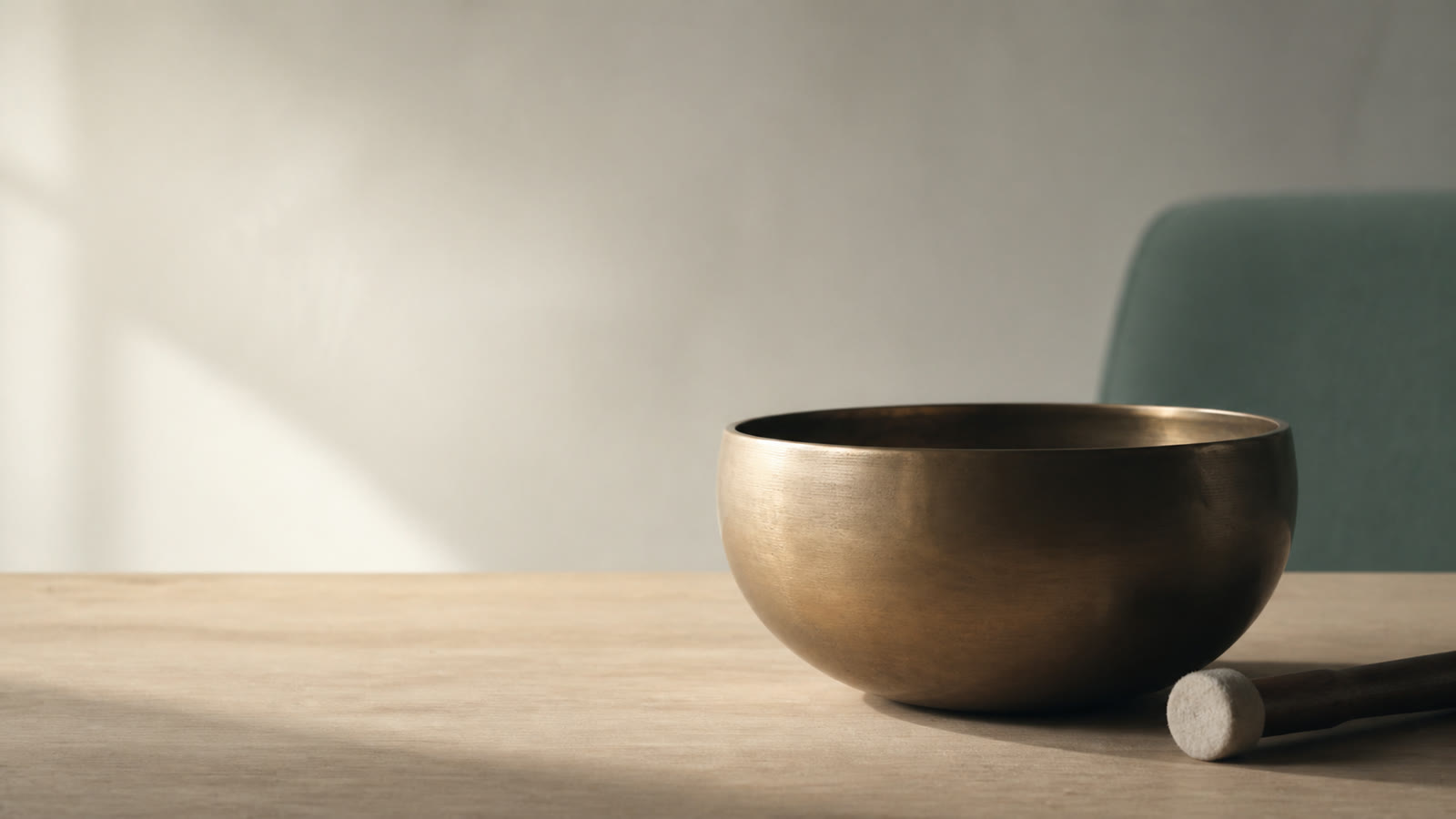
What is a singing bowl?
 Sustained tone · vibration
A singing bowl is a bowl-shaped instrument that produces sustained tones and
vibrations when it is gently struck or played around the rim.
In this programme it is introduced as a simple tool for
Sound awareness
Bringing attention to sound
Focused listening
Following sound as it changes
Mindful relaxation
Creating an opportunity to pause and notice
Key message
Our focus today is mindful listening and workplace well-being.
Singing bowl
Basic background
Singing bowls are commonly associated with Himalayan and Asian contemplative
traditions and are also used today in various relaxation and mindfulness settings.
For this workplace programme, our focus is practical.
Key message
Today we are learning a simple sound-awareness practice, not a sound-healing
certification technique.
Our practical focus
Sound
Listening
Awareness
Relaxation
Materials
What are singing bowls made of?
Singing bowls may be made from different materials.
Type 01
Metal singing bowls
Commonly made using metal or metal alloys.
Type 02
Crystal singing bowls
Commonly made using quartz-based material.
Different bowls
may produce different TonesResonanceVibrations
may produce different TonesResonanceVibrations
Key message
For today's practice, the important skill is not identifying every type of bowl.
The focus is how we listen and notice.
From contact to silence
How does a singing bowl produce sound?
Stage 01
Gentle contact
The mallet makes contact with the bowl.
→
Stage 02
Vibration
The bowl vibrates.
→
Stage 03
Resonance
A tone can be heard.
→
Stage 04
Fading
The sound gradually becomes softer.
Contact
Silence
Key message
Sound begins with vibration and changes over time.
Technique
Gentle strike vs rim playing
1Gentle strike
A suitable mallet gently contacts the bowl.
ResultA clear tone begins and gradually fades.
2Rim playing
A suitable mallet is moved gently around the rim.
ResultThe bowl can produce a more sustained tone.
Remember
GentleControlledComfortable
Force is not necessary.
Safe & appropriate use
Comfort comes first
Do
- Keep the volume comfortable
- Use gentle and controlled movements
- Give participants personal space
- Explain before producing sound
- Allow participants to sit comfortably
- Respect participant choice
Avoid
- Sudden very loud sounds
- Playing very close to someone's ears
- Forcing participation
- Creating unnecessary discomfort
Key message
Safe practice begins with participant comfort and choice.
The mindful sound process
Pause → Listen → Notice → Relax
1
Pause
Stop for a moment and settle your attention.
2
Listen
Bring your attention to the sound.
3
Notice
Notice the tone, vibration, changes and fading sound.
4
Relax
Remain comfortable as the sound gradually fades.
Remember
Nothing to force. Simply listen and notice.
Trainer demonstration
Watch the process
Anna demonstrates
Pause
Listen
Notice
Relax
While observing, notice
- How the bowl is handled
- How the sound begins
- How attention follows the sound
- How the sound is allowed to fade naturally
Participant task
Observe first. Practice next.
LO2 Check
Guided practice
Now you try
Step 1Pause and settle your attention.
Step 2Listen when the sound begins.
Step 3Notice the sound as it changes and fades.
Step 4Remain comfortable and relaxed.
Trainer observation
- Participant pauses
- Participant listens attentively
- Participant notices / follows the sound
- Participant completes the process appropriately
Success criteria
Participant demonstrates ONE simple mindful relaxation technique using sound awareness.
Module 2 recap
Pause→
Listen→
Notice→
Relax
LO2 achieved ✓
15minute
break
break
RefreshResetReturn
Next
Module 03 · 30 minutes
Positive Workplace Interaction
Appreciate → Listen → Respond respectfully
03
Module · 30 minutes
Positive Workplace Interaction
Appreciate→Listen→Respond respectfully
LO3
By the end of this module, participants will be able to:
Identify ONE practical action to manage stress and support positive interaction at work.
Definition
Positive workplace interaction
Positive workplace interaction means communicating and responding to others in ways
that support —
Respect
Understanding
Cooperation
Constructive communication
It does not mean that everyone must always agree.
Key message
We can communicate differences while remaining respectful and constructive.
Why does it matter?
Pressure can affect communication
When we are under pressure, we may become
- Less patient
- More reactive
- Easier to misunderstand
- Less attentive to others
Awareness gives us an opportunity to choose our response.
Simple process
Pressure
Notice
Pause
Choose how to respond
Key message
How we respond can influence the quality of the interaction.
Three simple behaviours
Appreciate → Listen → Respond respectfully
Behaviour 01
Appreciate
Recognise a positive contribution.
Behaviour 02
Listen
Give full attention before responding.
Behaviour 03
Respond respectfully
Use calm and constructive language.
Key message
Small communication behaviours can make workplace interaction more constructive.
Behaviour 01 of 03
Appreciate
Recognise something positive or helpful.
Instead of focusing only on what went wrong, notice what can genuinely be acknowledged.
Key message
Genuine appreciation helps people feel recognised.
Examples
Say
“Thank you for letting me know early.”
Say
“I appreciate you completing this quickly.”
Say
“Thank you for helping the team.”
Behaviour 02 of 03
Listen
Give the other person attention before responding.
Practise
- Allow the person to finish
- Listen to understand the message
- Avoid unnecessary interruption
- Clarify when needed
Instead of
“No, that's not what happened.”
Try
“Let me understand what happened first.”
Key message
Listening does not mean agreeing. It means understanding before responding.
Behaviour 03 of 03
Respond respectfully
Use calm and constructive language.
Reactive response
More constructive response
“You always give me things at the last minute!”
→
“I understand this is urgent. Let's look at what needs priority.”
“This is not my problem.”
→
“Let's clarify what support is needed.”
Key message
We can be clear and respectful at the same time.
Activity
Workplace scenario
What would you do?
The situation
You are already managing several urgent tasks.
A colleague approaches and says —
They say
A colleague approaches and says —
“Can you finish this for me today? I need it urgently.”
You notice yourself becoming frustrated.
How could you use
Appreciate→
Listen→
Respond respectfully
Possible response
Appreciate
“Thanks for letting me know this is urgent.”
Listen
“Can you explain what needs to be completed today?”
Respond respectfully
“I'm managing two urgent tasks now. Let's decide which item should take priority.”
Activity
Pair practice · Role play
Let's practise
Work with a partner.
Person A
Employee already under pressure.
⇄
Then
switch roles
switch roles
Person B
Colleague requesting urgent assistance.
Practise 1Appreciate
→
Practise 2Listen
→
Practise 3Respond respectfully
⇄Switch roles
Debrief
“What changed when the response became calmer and more constructive?”
Take it back to work
One practical action
Think of ONE practical action you can use when you notice workplace pressure.
Examples
- Notice my stress signs earlier
- Pause before responding
- Listen fully before answering
- Use respectful language
- Recognise a colleague's contribution
- Use mindful sound awareness during an appropriate pause
My practical action
“At work, I will.”
This is a practical reflection — not a SMART Action Plan.
LO3 Check
Assessment
Check your learning
Identify ONE practical action to manage workplace stress
and/or support positive workplace interaction.
My action
Success criteria
Participant identifies ONE appropriate and practical workplace action.
Module 3 recap
Appreciate→
Listen→
Respond respectfully→
Take practical action
LO3 achieved ✓
Next · 15-minute break
15minute
break
break
PauseRefreshReturn
When we return
Experience · 30 minutes
Guided Sound Relaxation
Return quietly and make yourself comfortable
Before we begin
Guided Sound
Relaxation
30 minutes · Participation is voluntary
✓Choose a comfortable seated or resting position
✓Give yourself enough personal space
✓Silence your phone if possible
✓Adjust your position whenever needed
✓Participation is voluntary
✓If you feel uncomfortable, you may stop or simply sit quietly
Key message
Your comfort comes first.
During this experience
Simply listen & notice
ListenNotice when the sound begins.
NoticeObserve the tone, resonance and change.
FollowListen as the sound gradually fades.
RestNotice the quiet moment after the sound.
Nothing to achieve.
Nothing to perform.
Simply listen and notice.
Quiet integration
Take a quiet moment
Notice 01How does your body feel now?
Notice 02What is the quality of your attention?
Notice 03What did you notice during the sound experience?
There is no right or wrong experience.
Allow a short quiet reflection before the final recap
Simply notice
Final recap
Our learning journey
LO1
Stress awareness
Identify at least 2
common signs of workplace stress.
✓ Physical✓ Mental✓ Emotional
LO2
Mindful sound
Demonstrate 1
simple mindful relaxation technique using sound awareness.
✓ Pause → Listen → Notice → Relax
LO3
Workplace application
Identify 1
practical action to manage stress and support positive interaction.
✓ Appreciate → Listen → Respond respectfully
Remember
Identify 2 → Demonstrate 1 → Identify 1
Post-assessment · Reflection · Evaluation
Check · Reflect · Feedback
1
Post-assessment
Complete the programme knowledge check.
2
Personal reflection
Complete —
“One thing I am taking away from today's session is.”
3
Programme evaluation
Please complete the programme evaluation.
QR code /
evaluation link here
evaluation link here
Key message
Your reflection and feedback help turn today's experience into practical learning.
Thank you
Mindful Sound for Workplace PerformanceNoticeRecognise what is happening.
PauseBring awareness to the present moment.
ChooseRespond with greater awareness and respect.
We may not always be able to control the pressure around us, but we can become more
aware of what is happening within us and choose how we respond.
Thank you for your presence and participation.
Anna Lim
